How the Trinity Is Used as a Symbol in Art of the Middle Ages
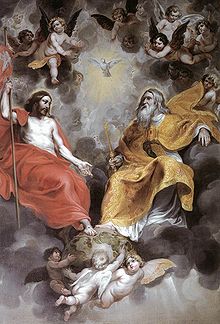
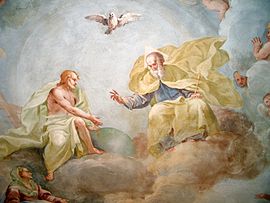
Holy Trinity, fresco by Luca Rossetti da Orta, 1738–nine (St. Gaudenzio Church at Ivrea).
The Trinity is near commonly seen in Christian art with the Holy Spirit represented by a dove, as specified in the gospel accounts of the baptism of Christ; he is nigh e'er shown with wings outspread. Even so depictions using three anthropomorphic figures appear occasionally in most periods of art.[i]
The Father and the Son are usually differentiated past age, and later by clothes, only this likewise is not ever the case. The usual depiction of the Father equally an older human with a white bristles may derive from the biblical Ancient of Days, which is oft cited in defense of this sometimes controversial representation. However, in Eastern Orthodoxy the Aboriginal of Days is usually understood to be God the Son, not God the Begetter—early Byzantine images prove Christ every bit the Ancient of Days,[2] but this iconography became rare. When the Begetter is depicted in art, he is sometimes shown with a halo shaped similar an equilateral triangle, instead of a circle. The Son is often shown at the Male parent's right hand.[Acts 7:56] He may be represented by a symbol—typically the Lamb or a cantankerous—or on a crucifix, so that the Male parent is the but human figure shown at full size. In early on medieval art, the Father may be represented by a hand actualization from a cloud in a blessing gesture, for example in scenes of the Baptism of Christ. Later on, in the West, the "Throne of Mercy" (or "Throne of Grace") became a common delineation. In this style, the Father (sometimes seated on a throne) is shown supporting either a crucifix[3] or, later, a slumped crucified Son, similar to the Pietà (this type is distinguished in High german equally the Not Gottes)[4] in his outstretched arms, while the Dove hovers above or in betwixt them. This subject continued to exist pop until the 18th century at least.
By the terminate of the 15th century, larger representations, other than the Throne of Mercy, became finer standardised, showing an older effigy in plain robes for the Father, Christ with his torso partly bare to display the wounds of his Passion, and the dove in a higher place or around them. In before representations both Begetter, especially, and Son often wear elaborate robes and crowns. Sometimes the Father lone wears a crown, or even a papal tiara.
Eastern Orthodox tradition [edit]
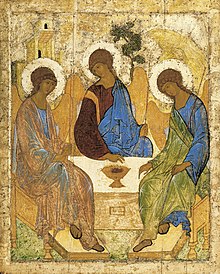
Direct representations of the Trinity are much rarer in Eastern Orthodox fine art of whatever period—reservations about depicting the Father remain fairly stiff, every bit they were in the West until the loftier Middle Ages. The Second Quango of Nicea in 787 confirmed that the delineation of Christ was allowed; the situation regarding the Begetter was less clear. The usual Eastern Orthodox representation of the Trinity was through the "Sometime Testament Trinity" of the iii angels visiting Abraham—said in the text to be "the Lord"[Genesis 18:1–15]. However scholars generally agree that the directly representation of the Trinity began in Greek works from the 11th century onwards, where Christ is shown as an baby sitting on the Father's lap, with the Dove of the Holy Spirit also present. Such depictions spread to the West and became the standard type there, although with an adult Christ, as described in a higher place. This type subsequently spread back to the Eastern Orthodox world where post-Byzantine representations similar to those in the W are not uncommon outside Russia.[five] The subject long remained sensitive, and the Russian Orthodox Church at the Great Synod of Moscow in 1667 finally forbade depictions of the Begetter in man form. The canon is quoted in total here considering information technology explains the Russian Orthodox theology on the subject:
Affiliate ii, §44: It is most cool and improper to depict in icons the Lord Sabaoth (that is to say, God the Father) with a grey beard and the Simply-Begotten Son in His bosom with a dove between them, considering no-i has seen the Male parent according to His Divinity, and the Father has no mankind, nor was the Son built-in in the flesh from the Father earlier the ages. And though David the prophet says, "From the womb before the forenoon star have I begotten Thee"[Psalm 109:3], that nascence was not fleshly, but unspeakable and incomprehensible. For Christ Himself says in the holy Gospel, "No human being hath seen the Father, salvage the Son".cf. [John half-dozen:46] And Isaiah the prophet says in his fortieth chapter: "To whom take ye likened the Lord? and with what likeness accept ye made a similitude of Him? Has not the artificier of woods made an image, or the goldsmiths, having melted aureate, gilt it over, and fabricated information technology a similitude?"[Isa 40:18–19] In like way the Apostle Paul says in Acts[Acts 17:29] "Forasmuch then as we are the offspring of God, we ought not to think that the Godhead is like unto gold or silverish or stone, graven by art of man'due south imagination." And John Damascene says: "Only furthermore, who can make a similitude of the invisible, incorporeal, uncircumscribed and undepictable God? Information technology is, then, uttermost insanity and impiety to requite a form to the Godhead" (Orthodox Faith, 4:16). In like style St. Gregory the Dialogist prohibits this. For this reason nosotros should only form an agreement in the mind of Sabaoth, which is the Godhead, and of that nativity before the ages of the But-Begotten-Son from the Male parent, simply nosotros should never, in whatever wise draw these in icons, for this, indeed, is impossible. And the Holy Spirit is non in essence a dove, only in essence he is God, and "No man hath seen God", as John the Theologian and Evangelist bears witness[John one:18] and this is so even though, at the Hashemite kingdom of jordan at Christ's holy Baptism the Holy Spirit appeared in the likeness of a dove. For this reason, it is fitting on this occasion only to depict the Holy Spirit in the likeness of a dove. But in any other place those who have intelligence volition not depict the Holy Spirit in the likeness of a dove. For on Mount Tabor, He appeared equally a cloud and, at another time, in other ways. Furthermore, Sabaoth is the name not only of the Father, but of the Holy Trinity. Co-ordinate to Dionysios the Areopagite, Lord Sabaoth, translated from the Jewish tongue, ways "Lord of Hosts". This Lord of Hosts is the Holy Trinity, Begetter, Son and Holy Spirit. And although Daniel the prophet says that he beheld the Ancient of Days sitting on a throne, this should non be understood to refer to the Begetter, only to the Son, Who at His second coming will judge every nation at the dreadful Judgment.[6]
Oriental Orthodox traditions [edit]

The Coptic Orthodox Church never depicts God the Father in art although he may be identified by an area of effulgence within art such as the heavenly glow at the top of some icons of the baptism of the Lord Jesus Christ. In contrast, the Ethiopian Orthodox Tewahedo Church has many ancient icons depicting the Holy Trinity equally three distinct persons.[7] [8] These icons oft depict all three persons sitting upon a single throne to signify unity. The Eritrean Orthodox Tewahedo Church follows the aforementioned exercise.
Scenes [edit]
Only a few of the standard scenes in Christian art normally included a representation of the Trinity. The accounts in the Gospels of the Baptism of Christ were considered to show all three persons as present with a separate function. Sometimes the other ii persons are shown at the top of a crucifixion. The Coronation of the Virgin, a popular bailiwick in the West, ofttimes included the whole Trinity. Simply many subjects, such as Christ in Majesty or the Last Judgement, which might be thought to require depiction of the deity in the about amplified form, only show Christ. At that place is a rare subject where the persons of the Trinity make the determination to incarnate Christ, or God sending out the Son. Even more rarely, the Angel of the Annunciation is shown being given the mission.[9]
Less mutual types of depiction [edit]
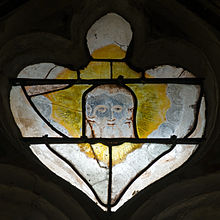
Stained drinking glass window depicting the Trinity in three persons. Saint Martin church building, Courgenard, France.
Particularly in the 15th century, and in the less public grade of illuminated manuscripts, in that location was experimentation with many solutions to the issues of depicting the three persons of the Trinity. The delineation of the Trinity as 3 identical persons is rare, considering each person of the Trinity is considered to have distinct attributes. Nonetheless, the earliest known depiction of God the Father equally a human being figure, on the 4th century Dogmatic Sarcophagus, shows the Trinity every bit 3 similar bearded men creating Eve from Adam, probably with the intention of affirming the consubstantiality recently made dogma in the Nicene Creed. There are many like sarcophagi, and occasional images at intervals until a revival of the iconography in the 15th century.[x] The delineation was finally formally condemned by Pope Benedict Xiv in the 18th century.[11] Even rarer is the depiction of the Trinity as a single anthropoid figure with iii faces (Latin "Vultus Trifons"), because the Trinity is defined every bit three persons in ane Godhead, non one person with three attributes (this would imply Modalism, which is defined every bit heresy in traditional Orthodox Christianity). Such "Cerberus" depictions of the Trinity as iii faces on ane head were mainly made amongst Catholics during the 15th to 17th centuries, but were condemned later on the Catholic Quango of Trent, and again by Pope Urban Viii in 1628,[12] and many existing images were destroyed.
The Trinity may likewise be represented abstractly by symbols, such equally the triangle (or three triangles joined together), trefoil or the triquetra—or a combination of these. Sometimes a halo is incorporated into these symbols. The use of such symbols are oftentimes establish not merely in painting but also in needlework on tapestries, vestments and antependia, in metalwork and in architectural details.
Gallery [edit]
Throne of Mercy [edit]
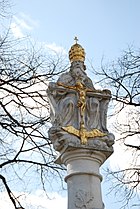
A representation of the Holy Trinity in which God the Father is holding the crucified Christ and the Holy Ghost is represented as a pigeon.[thirteen]
-

-
-

-

Weilheim, Mercy Seat with Mary and John the Baptist
Different depictions [edit]
Four 15th century depictions of the Coronation of the Virgin bear witness the primary ways of depicting the persons of the Trinity.
-

The conventional depiction, with older Begetter, dove, and Christ showing the wounds of his Passion
-

Enguerrand Quarton with Christ and God the Father equally identical figures, and a pigeon, as specified by the cleric who commissioned the work
-

Folio from an English language Book of Hours (c. 1500), with three differentiated human figures for the Trinity
Depictions using 2 different human figures and a dove [edit]
-

Statuette in the Black Abbey, Kilkenny, Ireland; inscribed "1264" merely idea to actually date to the 14th century[14]
-

"Throne of Mercy", Gothic, Sweden
-

-

"Gottes Not", Jan Polack (Smoothen creative person working in Germany), 1491
-

Wall Painting in Georgia'due south ancient Monastery, Shio-Mghvime
Other depictions [edit]
-
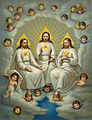
Holy Trinity by Fridolin Leiber (1853–1912)
-

Allegory of the Holy Trinity, painted every bit three faces fused in 1, medieval fresco in Perugia
-

Trinity, 15th-century fresco, Castelletto Cervo (Vercelli, Italy), St Peter and St. Paul Church
-

Holy Trinity past Yard. Presnyakov (inspired by Andrei Rublev's famous icon)
-
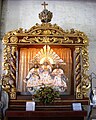
Holy Trinity statue in the style of Fridolin Leiber'due south painting, Santísima Trinidad Quasi-Parish, Malolos City, Philippines.[15]
Meet as well [edit]
References [edit]
- ^ See below and G Schiller, Iconography of Christian Art, Vol. I, 1971, Vol II, 1972, (English trans from German), Lund Humphries, London, figs I;5–16 & passim, ISBN 0-85331-270-2 and ISBN 0-85331-324-5
- ^ Cartlidge, David R., and Elliott, J.K.. Art and the Christian Apocrypha, pp. 69–72 (illustrating examples), Routledge, 2001, ISBN 0-415-23392-5, ISBN 978-0-415-23392-7, Google books
- ^ Yard Schiller, Iconography of Christian Art, Vol. Ii, 1972, (English trans from High german), Lund Humphries, London, figs I;5–16 & passim, ISBN 0-85331-270-2 and ISBN 0-85331-324-5, pp. 122–124 and figs 409–414
- ^ G Schiller, Iconography of Christian Art, Vol. II, 1972, (English trans from German), Lund Humphries, London, figs I;5–16 & passim, ISBN 0-85331-270-2 and ISBN 0-85331-324-5, pp. 219–224 and figs 768–804
- ^ Bigham, 89–98
- ^ The Tome of the Corking Quango of Moscow (1666–1667 A.D.), Ch. 2, 43–45; tr. Hierodeacon Lev Puhalo, Canadian Orthodox Missionary Journal
- ^ "The Ethiopian Orthodox Tewahedo Church Icons". Archived from the original on November 3, 2008.
- ^ "An Ethiopian Iconostasis". Retrieved 2012-01-02 .
- ^ for both, G Schiller, Iconography of Christian Art, Vol. I,1971, Vol II, 1972, (English trans from High german), Lund Humphries, London, ISBN 0-85331-270-2 and ISBN 0-85331-324-five, pp. half-dozen–12 and figs 10–16
- ^ Schiller, I, figs 7, 10, 11
- ^ Panofsky, Erwin, "Again "The Friedsam Annunciation and the Problem of the Ghent Altarpiece", The Art Bulletin, Vol. 20, No. 4 (Dec., 1938), pp. 419-442, College Art Clan, JSTOR
- ^ Guss, David Grand. (2006). "The Gran Poder and the Reconquest of La Paz" (PDF). Periodical of Latin American Anthropology. 11 (ii): 294–328. doi:10.1525/jlca.2006.11.2.294. ISSN 1085-7052.
- ^ Hartmann, P.W., Das grosse Kunstlexikon: Gnadenstuhl, archived from the original on 2019-03-29
- ^ Brady, Margery (1987). Kilkenny: Its Architecture & History. ISBN9780862811808.
- ^ "Archived re-create". Archived from the original on Baronial 30, 2012. Retrieved Dec 29, 2012.
{{cite spider web}}: CS1 maint: archived re-create equally championship (link)
Source: https://en.wikipedia.org/wiki/The_Trinity_in_art

Post a Comment for "How the Trinity Is Used as a Symbol in Art of the Middle Ages"